
Driveways and parking lots across Sedgwick County
Paving Contractors in Wichita, KS
New asphalt built on a compacted base, plus the sealing, crack work and striping that keep it from breaking up after a Kansas winter.
- Free on-site estimates
- Written, itemized quote before any work
- Subgrade and base checked before new asphalt goes down
Pavement That Has to Handle Ice, Heat and Clay
Paving contractors in Wichita have to build asphalt for two very different seasons. The city's average window for freezing temperatures runs from October 25 to April 9, and the National Weather Service puts the average number of 100-degree days at Wichita's airport at 12.4 a year, with 53 in 2011. A driveway or parking lot here gets months of freeze-thaw cycles and then weeks of hot sun that softens the surface. Asphalt laid on a good base, at the right thickness, and kept sealed handles both. Asphalt laid on soft, wet ground does not.
Why the base matters more than the topcoat
Much of Sedgwick County sits on clay-rich soil. USDA soil survey maps for parts of the county show silty clay series such as Rosehill and Goessel, rated hydrologic soil group D, which means water soaks in very slowly when the ground is wet. Soil like that stays saturated after rain, swells and shrinks with moisture, and loses strength when water freezes in it. If asphalt goes straight onto that subgrade, or onto a thin layer of rock, it flexes under every car until it cracks.
For a residential driveway, HomeGuide's cost guide describes a typical build as 2 to 3 inches of compacted asphalt over 6 to 8 inches of compacted gravel base, with thicker sections for heavy vehicles and 4 inches or more for commercial lots. On every job we check the subgrade first. Soft spots are dug out and replaced with compacted stone, and the base is graded so water runs off the pavement instead of sitting under it.
Drainage and freeze-thaw
Water is the main enemy of asphalt in Kansas. It gets into a crack, freezes, expands, and pries the crack wider. In spring it softens the base below. A surface that sheds water to the edges, edges that are supported rather than left to crumble into the lawn, and cracks sealed before winter all slow that cycle down. We set slope and drainage on each job and point out low spots where water will collect.
Summer heat and timing
Hot asphalt has to be compacted while it is still workable. Industry guidance notes that ground temperature is the most critical factor in cold-weather paving and that a 3-inch lift holds its heat roughly four times as long as a 1.5-inch lift. In practice, that means we avoid paving on cold ground in late fall and early spring, and in summer we plan around the hottest part of the day so new asphalt is not marked up by traffic before it has cooled.
Wichita drive approaches and permits
The stretch between the street and your property line is public right-of-way, and Wichita's city code treats the drive approach there separately from the driveway. Under Chapter 10.12 as adopted in 2016, work on drive approaches, curbs and sidewalks in the right-of-way needs a permit from the City Engineer and an inspection, approaches are to be concrete unless the city allows otherwise, and widening or replacing a drive counts as a new approach. The 2016 version of Chapter 10.16 limits an approach to 30 feet wide without written approval. The city may have amended these rules since, so we check the current requirements with the city before any approach work. If your new driveway ends at an existing concrete apron, none of this may apply. If you want the approach widened or moved, we tell you at the estimate what the city process involves before any work is planned.
What a typical driveway job includes
- Measuring the area and checking slope, drainage and the curb apron
- Removing old asphalt or concrete and hauling it away
- Digging out soft subgrade and replacing it with compacted stone
- Grading and compacting the gravel base
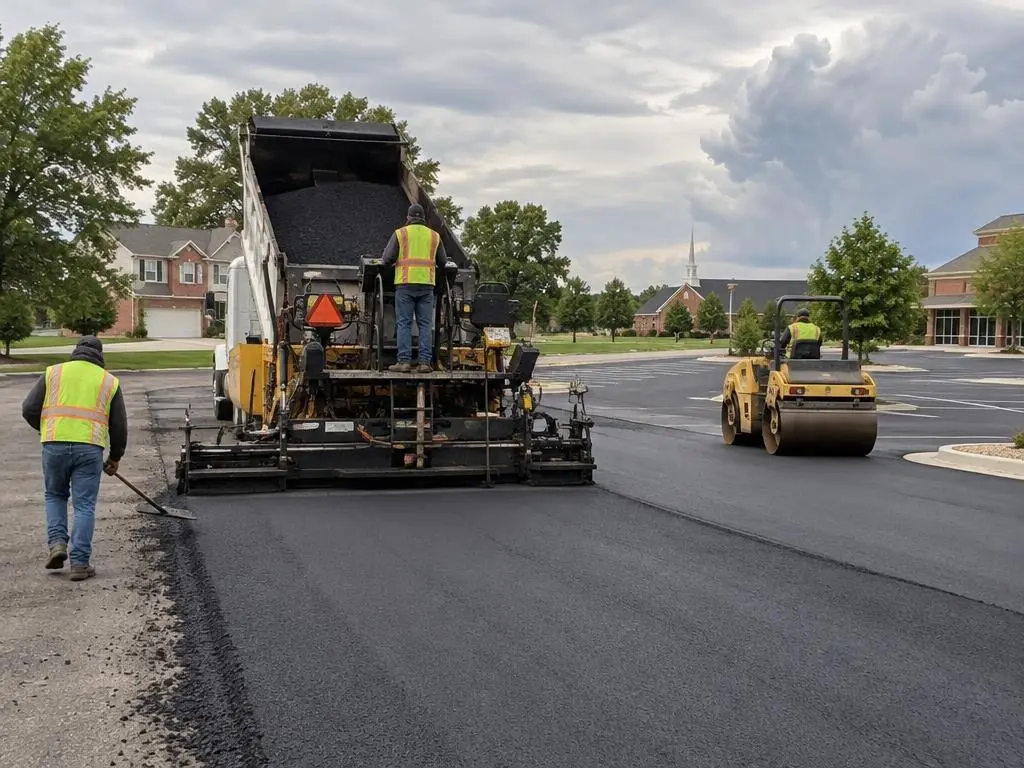
- Placing and rolling hot-mix asphalt to the thickness in your quote
- Finishing edges and transitions to the garage slab and approach
- Telling you when to drive on it and when it can be sealed
Our Asphalt Paving Services
Six services cover asphalt from the day it is laid through the years of upkeep that decide how long it lasts.
Asphalt Driveway Paving
New and replacement asphalt driveways built on a compacted stone base, with slope and edges set for drainage.
Learn more →Parking Lot Paving
New commercial lots, overlays and reconstruction for businesses, churches and multifamily properties.
Learn more →Sealcoating
Cleaning, crack filling and two coats of sealer to slow sun and water damage on driveways and lots.
Learn more →Asphalt Repair & Patching
Pothole repair, saw-cut patches and full-depth fixes for soft spots, sunken areas and broken edges.
Learn more →Crack Sealing
Cracks cleaned out and filled with hot rubberized sealant before winter, to keep water out of the base.
Learn more →Line Striping
Parking stall layout and restriping, accessible spaces, arrows, fire lanes and curb painting.
Learn more →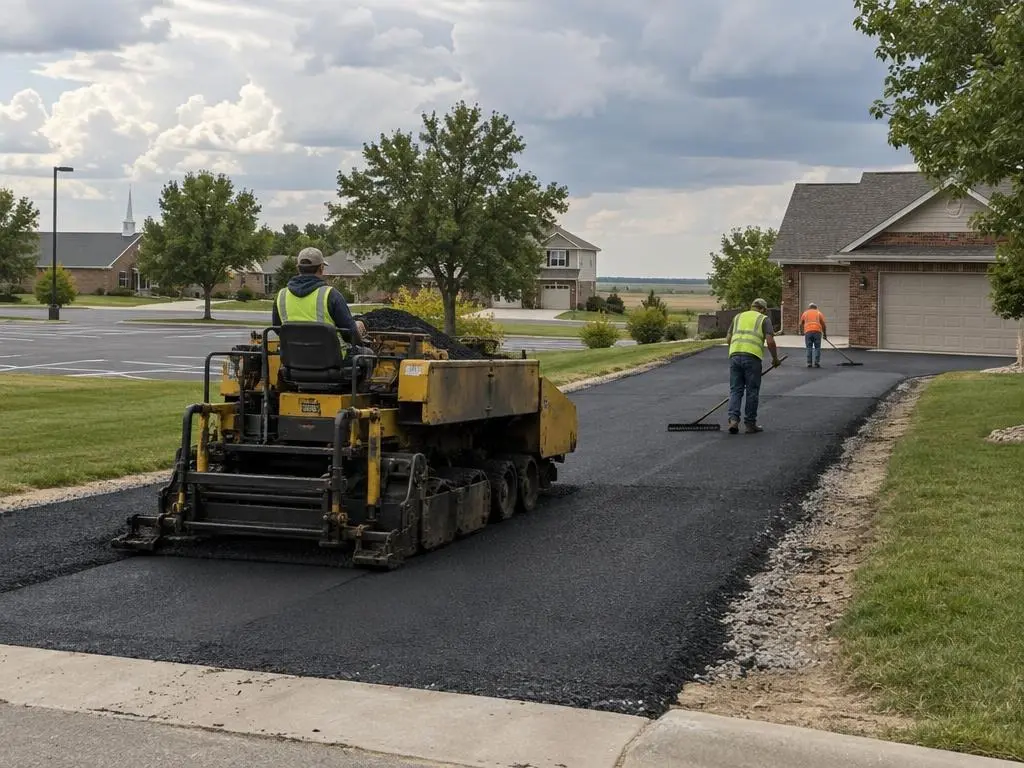
Why Homeowners Call Paving Contractors Wichita
Base first
Soft subgrade is dug out and replaced with compacted stone before asphalt is placed.
Thickness in writing
Your quote states the base depth and the compacted asphalt thickness for each area.
Weather-aware scheduling
We pave when ground and air temperatures let the mix compact, and seal only in dry, mild weather.
Right-of-way checked
We tell you up front whether your project reaches the city drive approach and what that involves.
Where We Work
Wichita is home base, and we work across Sedgwick County and nearby South-Central Kansas communities such as Derby, Haysville, Park City, Bel Aire, Maize, Goddard, Valley Center and Andover. Soil, drainage and the age of existing pavement vary from one neighborhood to the next, and each city has its own rules for work in the public right-of-way. The Wichita drive approach rules described here apply inside Wichita city limits; outside them, we check what the local city or county requires before work that touches the street is scheduled. The individual town pages explain the local details.
- Paving Contractors in Wichita, KS
- Paving Contractors in Derby, KS
- Paving Contractors in Haysville, KS
- Paving Contractors in Mulvane, KS
- Paving Contractors in Park City, KS
- Paving Contractors in Bel Aire, KS
- Paving Contractors in Kechi, KS
- Paving Contractors in Valley Center, KS
- Paving Contractors in Maize, KS
- Paving Contractors in Goddard, KS
- Paving Contractors in Cheney, KS
- Paving Contractors in Clearwater, KS
- Paving Contractors in Andover, KS
- Paving Contractors in Augusta, KS
- Paving Contractors in Rose Hill, KS
- Paving Contractors in El Dorado, KS
- Paving Contractors in Newton, KS
- Paving Contractors in Hutchinson, KS
- Paving Contractors in McPherson, KS
- Paving Contractors in Wellington, KS
- Paving Contractors in Winfield, KS
- Paving Contractors in Sedgwick, KS
- Paving Contractors in Halstead, KS
- Paving Contractors in Colwich, KS
Common Questions
What does a new asphalt driveway run in Wichita?
Published guides list new asphalt driveways at roughly $5 to $12 or more per square foot (HomeGuide) and $7 to $15 per square foot (Angi). HomeGuide lists a 20 by 20 foot driveway at about $2,000 to $4,800. Removal of old pavement, soft-soil repairs and approach work add to that. We give you a written price after seeing the site.
What thickness is right for a residential asphalt driveway?
A common residential build is 2 to 3 inches of compacted asphalt over 6 to 8 inches of compacted gravel base. Driveways that carry trucks, trailers or RVs need more of both. On Wichita's clay soils, the base depth matters as much as the asphalt itself.
Which months work for paving in Wichita?
Late spring through early fall, when the ground is warm and dry. Wichita's average freeze window runs from late October to early April, and paving on cold ground makes compaction difficult. We schedule around the weather rather than a fixed calendar.
Can new asphalt go over my old driveway?
Sometimes. An overlay can work when the old surface is cracked but still firmly supported. If the base has failed, with potholes, sunken areas or edges breaking off, an overlay will crack again in the same places, and removal is the better choice. We check the base before recommending either.
Does Wichita require a permit for driveway paving?
As adopted in 2016, Chapter 10.12 of the city code requires a permit from the City Engineer for work on the drive approach, curb or sidewalk in the public right-of-way, and treats widening or replacing a drive as a new approach. Paving that stays on your side of the property line generally is not covered by that chapter. City rules can change, so we confirm the current requirements for your address before work starts.
How soon can I drive on a new asphalt driveway?
Usually after a few days, longer in hot weather when the surface stays soft. Avoid turning the wheels while parked, parking in the same spot every day and setting kickstands or trailer jacks on it for the first weeks. Sealcoating should wait several months while the asphalt cures.
What lifespan can I expect from asphalt in Kansas?
Cost guides put typical asphalt driveway life at 15 to 30 years. Where a driveway falls in that range depends on the base, drainage and upkeep. Sealing every few years and filling cracks before winter help it last longer.
Get an Asphalt Paving Estimate
Free on-site estimates in Wichita and across Sedgwick County.